Important disclaimer
Haven provides general information only. Nothing on this page is legal advice, and it should not be treated as a substitute for advice from a qualified immigration lawyer or accredited legal representative. Immigration outcomes depend on the specific facts of your case. If you need case-specific guidance, consult a lawyer before making decisions or filing.
If you are trying to figure out which vaccines are needed for a green card medical exam, the short answer is that it depends on your age, your prior records, and whether you can prove immunity.
For adult applicants, the current CDC table used by civil surgeons shows that the most common immigration vaccine questions center on Tdap or Td, polio, MMR, hepatitis B, varicella, and influenza. The image you shared is a CDC age table, but the current official CDC vaccination instructions for civil surgeons are dated March 11, 2025, so it is better to use that version as the source of truth.
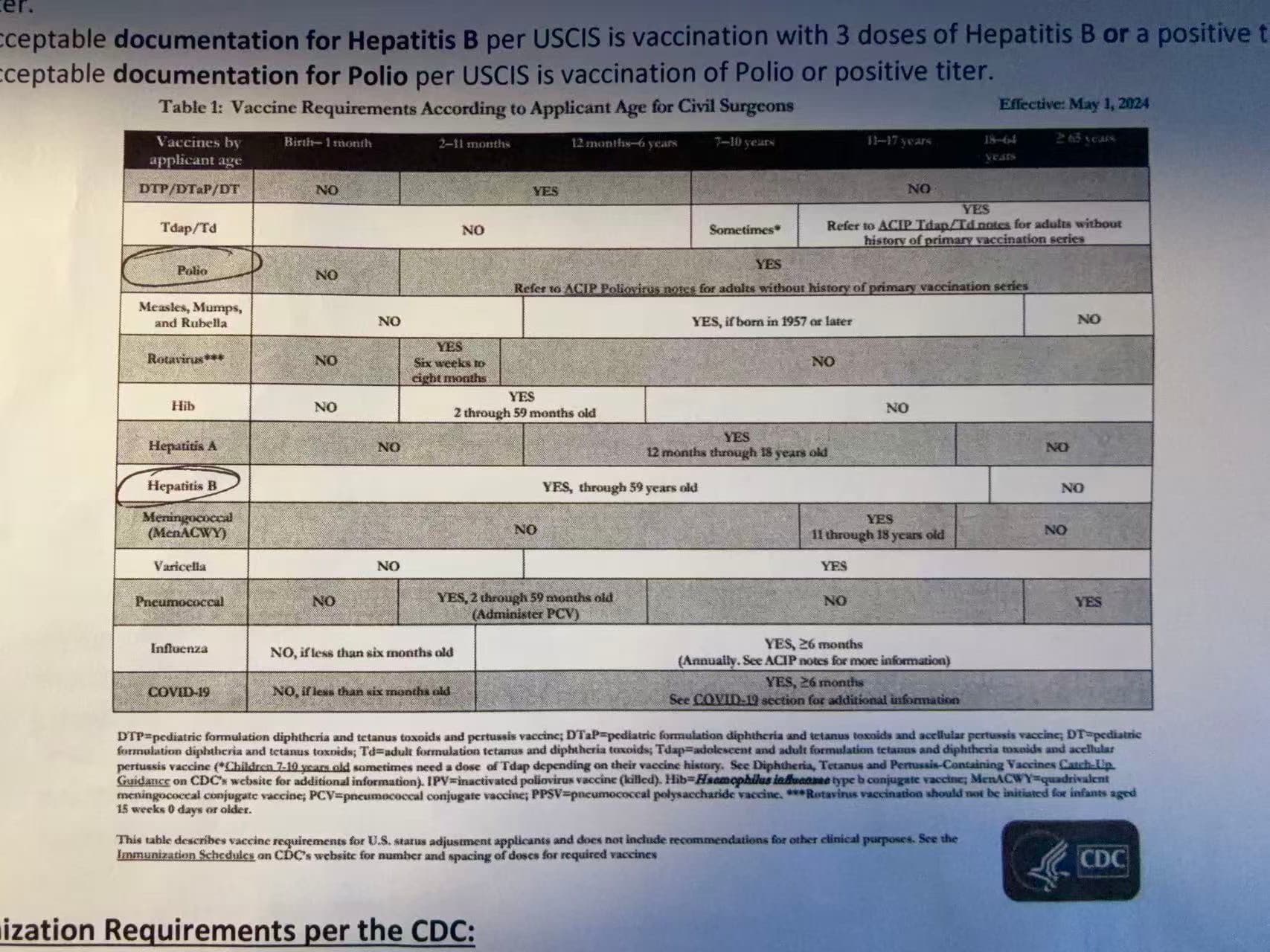
1. Which vaccines many adult applicants need to think about
According to CDC’s current Technical Instructions for Civil Surgeons, the vaccine list for immigration purposes includes diphtheria, tetanus, pertussis, polio, measles, mumps, rubella, hepatitis A, hepatitis B, meningococcal disease, varicella, pneumococcal disease, influenza, and a few child-focused vaccines such as Hib and rotavirus.
But that does not mean every adult needs every vaccine on that list. The CDC table is age-based, and for adults the list narrows.
- Tdap or Td: may be required if you do not have a documented primary series history that satisfies ACIP notes
- Polio: relevant for adults without a documented primary vaccination series
- MMR: generally relevant if you were born in 1957 or later
- Hepatitis B: required through age 59 under the CDC civil-surgeon table
- Varicella: relevant if you do not have acceptable proof of immunity or disease history
- Influenza: relevant when it is flu season or the vaccine is available
Haven can help you track this.
Turn timelines, action windows, and next steps into a personal plan grounded in your actual visa status, not a generic checklist.
2. What the current CDC table says for adults 18 to 59
The current CDC civil-surgeon instructions are the best source for this question because they are the table USCIS officers and civil surgeons ultimately rely on during the immigration medical process.
For adults in the 18 to 59 range, the CDC table points to polio only when the adult does not have a history of a primary vaccination series, requires hepatitis B through age 59, requires MMR if born in 1957 or later, requires varicella where immunity is not established, and treats influenza as a seasonal or availability issue.
- Polio is not an automatic requirement for every adult. The key issue is whether you can document a primary series or qualifying immunity.
- Hepatitis B is a common pain point because the immigration table covers adults through age 59.
- MMR and varicella often turn into documentation problems rather than vaccination problems if prior records are incomplete.
3. Why adults 60 and older should not assume the same list applies
One detail people often miss in screenshots is that the hepatitis B row does not work the same way for every adult age bucket. The CDC print table says hepatitis B is required through age 59, not indefinitely for all adults.
That means a 60-year-old applicant and a 35-year-old applicant may not face the same immigration vaccine checklist. The same table also shows pneumococcal relevance at older ages, which is another reason to let the civil surgeon map the table to your exact age rather than relying on a generic list from social media.
4. What counts as proof if you do not want to restart vaccines
CDC says acceptable vaccination documentation has to come from actual records with dates, not just self-reported memory. If your records are in another language, the applicant is responsible for providing a reliable English translation.
CDC also allows laboratory evidence of immunity for certain diseases if acceptable vaccination records are missing. That matters because some adults can solve the issue with records or titers instead of restarting everything.
- CDC says lab evidence of immunity is acceptable for measles, mumps, rubella, hepatitis A, hepatitis B, polio, and varicella
- For polio titers, CDC says the titer must include all three poliovirus types
- For varicella, CDC says a reliable written or oral history of disease can be enough in some cases
5. Do you need all doses completed before the I-693 is signed?
Usually no. This is one of the most important USCIS practical points for applicants who are worried about multi-dose series like hepatitis B.
CDC says applicants are generally required to receive at least one dose of each age-appropriate vaccine listed in the table if they are not already up to date. USCIS also says you are only required to receive a single dose of each vaccine when you visit the civil surgeon, and then you should continue the rest of the series with your regular provider as needed.
That is why many applicants can move forward with Form I-693 even if a vaccine series will continue after the appointment.
7. The practical adult checklist before your medical exam
If you want to reduce cost, delay, and confusion before your Form I-693 appointment, prepare like this.
- Bring every vaccine record you can find, including childhood records and records from outside the United States
- Translate non-English records before the appointment
- Ask whether titers make sense for MMR, hepatitis B, polio, or varicella if records are incomplete
- Do not assume you need to restart every vaccine series from zero
- Ask the civil surgeon which CDC table row applies to your exact age on the day of the exam
Sources